There are two ways to research a prospect before a meeting:
The thorough way takes 45-60 minutes. You dig through their website, annual reports, news mentions, LinkedIn profiles, and competitive landscape. You come away with deep understanding, but you've just spent an hour on one opportunity out of fifty.
The quick way takes 5 minutes. You skim the homepage, glance at a LinkedIn profile, and hope you'll learn enough in the meeting itself. You save time, but walk in with surface-level knowledge that buyers immediately sense.
Neither approach works at scale. The solution isn't to choose between depth and speed. It's to automate the gathering so you can focus on the synthesis.
In this guide, you'll learn: Why manual research doesn't scale, what a complete prospect intelligence report looks like, what can (and can't) be automated, and how to maintain quality while saving 85% of research time.
Jump to:
- The Research Scalability Problem
- What a 360° Prospect Intelligence Report Looks Like
- What Can Be Automated (And What Can't)
- The Secret Ingredient: Your Seller Context
- Automated Research in Practice
The Research Scalability Problem
Let's be honest about the math.
A typical B2B salesperson manages 30-50 active opportunities. Each opportunity involves multiple stakeholders, often at companies they've never researched before. Add prospecting activities (outreach to net-new accounts) and the research burden grows further.
If thorough research takes 45 minutes per company, a portfolio of 40 opportunities represents 30 hours of research work. Before any actual selling.
Most sellers solve this by cutting corners:
- Deep research on the biggest opportunities
- Surface-level prep for everything else
- Hope that meeting dynamics compensate for lack of preparation
The result? Inconsistent meeting quality. Some conversations feel prepared; others feel improvised. This is why so many sales meetings fail. Buyers experience this inconsistency, and trust erodes.
Key Insight: This isn't a discipline problem, it's a math problem. And the solution is intelligent automation.
What a 360° Prospect Intelligence Report Looks Like
When you automate research properly, you get comprehensive sales intelligence, not just data points:
Company Identity & Structure
- What they do and how they're organized
- Headquarters, size, key locations
- Recent changes or developments
Revenue Model
- How they make money
- Who their customers are
- Business model and market position
Strategic Priorities
- Stated goals and initiatives
- Recent announcements and investments
- What leadership emphasizes publicly
Decision-Making Dynamics
- Key executives and their backgrounds
- Organizational structure relevant to your solution
- How decisions typically get made
Competitive Landscape
- Who they compete with
- How they differentiate
- Pressures they face
BANT Qualification Indicators
- Budget signals from public information
- Authority structures
- Timing indicators from news and initiatives
Pro Tip: A complete research brief isn't a list of facts. It's a coherent picture of who they are and what they care about. This is what transforms research into intelligence.
What Can Be Automated (And What Can't)
Not all research is equal. Understanding the difference is key to effective automation.
High Automation Potential
| Research Area | What AI Does |
|---|---|
| Company basics | Gathers size, location, industry, founding, structure |
| Financial information | Synthesizes revenue, funding, growth trajectory |
| Recent news | Monitors announcements, press coverage, leadership changes |
| Organizational structure | Maps executives, departments, reporting lines |
| Digital footprint | Analyzes website content, social presence, tech stack |
| Competitive landscape | Identifies competitors, market positioning |
| Stakeholder profiles | Extracts LinkedIn data, career history, publications |
These are data gathering activities. They're essential inputs, but they don't require human judgment to collect.
Requires Human Judgment
| Area | Why It's Human |
|---|---|
| Synthesis | What does this information mean for our conversation? |
| Prioritization | What's most relevant given our solution? |
| Connection | How does this relate to what I already know about them? |
| Strategy | How should this intelligence shape my approach? |
| Relationship context | How does this person prefer to be approached? |
Automation gathers the raw material. Humans create the insight.
The Secret Ingredient: Your Seller Context
Here's what most research tools get wrong: they treat every seller the same.
But research should be personalized to who you are and what you sell. The same company looks different depending on whether you're selling a marketing automation platform, an HR management system, or a financial consulting engagement.
Intelligent automation uses three layers of context:
1. Your Sales Profile
- Your story and experience
- Your strengths and communication style
- Your target market and goals
2. Your Company Profile
- Your products and services
- Your value propositions
- Your ideal customer profile and buyer personas
3. Your Knowledge Base
- Customer success stories
- Presentations and case studies
- Product documentation
When AI knows what you sell and who you are, it can synthesize research that's relevant to your specific selling situation, not just generic company facts. This is how modern sales intelligence differs from traditional data gathering.
Key Insight: A research brief that knows you sell financial consulting will emphasize different aspects of a prospect than one designed for someone selling marketing software. Context matters.
Automated Research in Practice
Let me show you what this looks like:
Before: The Manual Approach
Sarah has a discovery call tomorrow. Her research:
- Visit company website, read About page (10 min)
- Look up the contact on LinkedIn (5 min)
- Google the company for recent news (10 min)
- Check for previous touchpoints in CRM (5 min)
- Review what she's selling and think about fit (10 min)
- Make notes on questions to ask (5 min)
Total: 45 minutes. She still missed the leadership change announced last week.
After: The Automated Approach
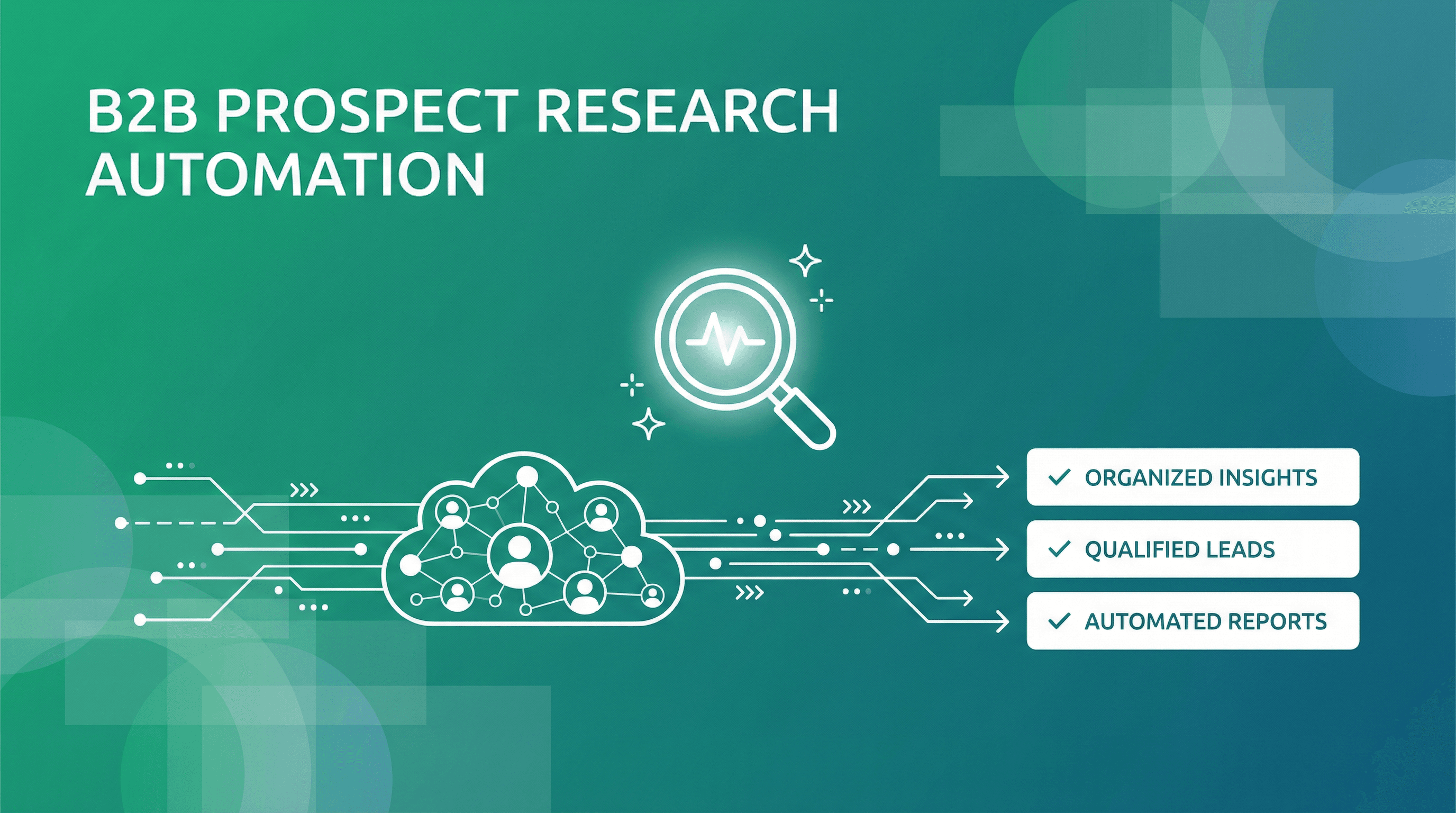
Sarah enters the company name. Within 2-3 minutes, the platform:
- Scrapes company website, LinkedIn, news sources, financial databases
- Synthesizes a 360° Prospect Intelligence Report
- Identifies key stakeholders and decision-making dynamics
- Highlights recent developments and strategic priorities
- Generates BANT qualification indicators
- Produces research tailored to what Sarah sells
Sarah spends 5 minutes reviewing and adding her own notes.
Total: 8 minutes. She knows more than she did with 45 minutes of manual research.
Time Savings Calculator: If you have 40 opportunities and save 35 minutes per opportunity, that's 23+ hours per month you can reinvest in actual selling.
Adding Contact Intelligence
Company research is half the picture. Understanding the people matters just as much.
Automated contact analysis provides:
Professional Background
- Career trajectory and tenure
- Previous companies and roles
- Education and credentials
Current Position
- Responsibilities and scope
- Reporting structure
- Time in role
Communication Insights
- How they present themselves publicly
- Content they share or engage with
- Communication preferences (when available)
Potential Motivations
- What might they care about given their role?
- What pressures do they likely face?
- What would success look like for them?
When you combine company intelligence with contact analysis, you walk into meeting preparation understanding both the organization and the people you're speaking with.
Common Automation Pitfalls
Automation can go wrong. Here's what to avoid:
Over-Relying on Automation
Automated research provides a foundation, not a complete picture. You still need to:
- Add context from previous conversations
- Think strategically about your approach
- Consider what you've learned from colleagues
Ignoring Stale Data
Automated sources can have outdated information. Always check for recent developments that might not have propagated to databases yet.
Trusting Without Verifying
AI-powered research occasionally surfaces inaccurate information. For high-stakes meetings, verify critical facts from primary sources.
Forgetting Relationship Context
Automated research captures public information. It doesn't capture what you've learned in previous conversations or what colleagues know about the account.
The Future of Prospect Research
The trajectory is clear: AI continues to improve at gathering, organizing, and synthesizing prospect intelligence.
What's changing:
- Speed: Research that takes minutes today will take seconds tomorrow
- Depth: AI synthesizes more sources than humans could manually process
- Personalization: Research increasingly tailored to your specific selling context
- Integration: Research flowing directly into preparation, meeting capture, and follow-up
What's not changing:
- Judgment: Humans decide what matters and how to act
- Strategy: Intelligence informs, but sellers execute
- Relationships: Trust is built through human connection
- Authenticity: Prepared conversations still need to feel genuine
Bottom Line: Automation handles the research, you bring the relationship. The sellers who thrive will be those who embrace automation for what it does well, while developing their own irreplaceable skills.
Ready to Transform Your Prospect Research?
Stop spending hours on manual research. DealMotion's 360° Prospect Intelligence gives you complete company and contact analysis in minutes, personalized to what you sell.
What you get:
- Complete company intelligence (structure, financials, strategy, C-suite)
- Contact analysis with career trajectory and communication insights
- Research tailored to your sales profile and company
- BANT qualification indicators